
Magyar Minute · Media Resources
Inside Hungary’s Versailles: The Story Behind Esterházy Palace
A visit to Fertőd through the palace’s music, the damage it survived and the people keeping it alive. Video, all four cover graphics, captions and editorial resources.
The companion articles are still in preparation. Contact Magyar Minute for editorial enquiries, permissions or additional material.
The Story
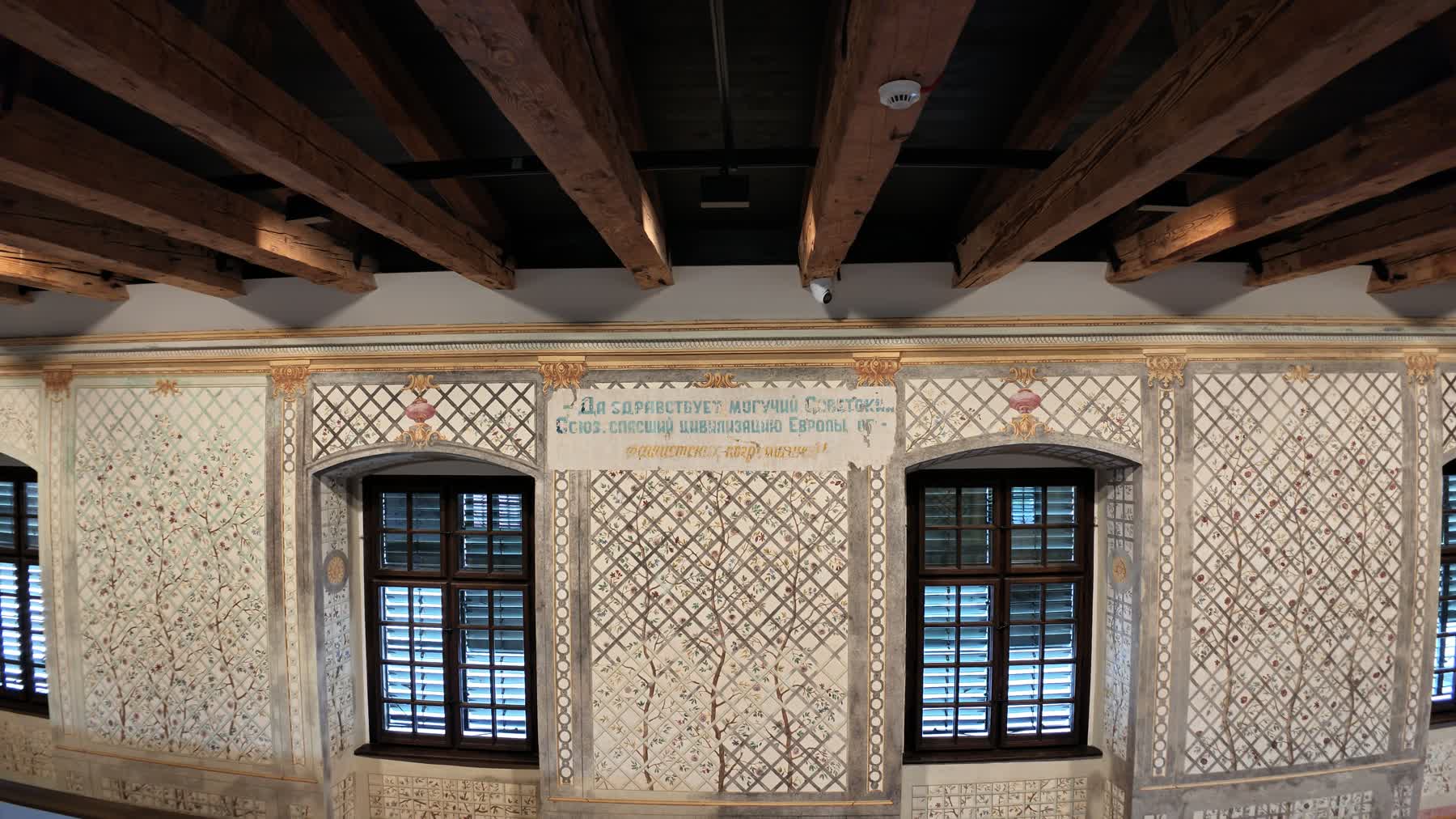
Ray Brown visits Esterházy Palace with his friend Alpár Kató, founder of Daily News Hungary, and host Csilla Sütő of the Eszterháza Center. Behind the gilded rooms is a story of aristocratic ambition, Joseph Haydn’s working life, wartime damage and restoration. A Soviet inscription on a palace wall brings its twentieth-century history into the visit.
Companion Article
The researched companion article is in preparation. It adds historical context to Ray’s spoken account.
Embed Code
Use the hosted player with selectable captions. Paste this into a Custom HTML block.
<div style="max-width:405px;margin:0 auto"><iframe title="Inside Hungary’s Versailles | Magyar Minute" src="https://play.gumlet.io/embed/6ae5008434bee2c4e8281cfe?caption_language=en" loading="lazy" style="border:none;width:100%;aspect-ratio:9/16;border-radius:12px;display:block" allow="autoplay;encrypted-media;picture-in-picture;fullscreen" allowfullscreen></iframe></div>
All Four Cover Graphics
Original PNGs supplied by Magyar Minute. Preserve the full composition. These are illustrated promotional composites: historical figures and settings are illustrative, not archival photographs.




Download The Resource Pack
All four original graphics, two footage stills, five-language SRT and WebVTT captions, plain-text transcripts and a credit/readme file. The original video is a separate download above.
Download Graphics, Captions And Transcripts (ZIP)
Suggested Copy
Headline
Inside Hungary’s Versailles: The Story Behind Esterházy Palace
Introduction
At Esterházy Palace in Fertőd, Magyar Minute’s Ray Brown looks beyond the gilded rooms of “Hungary’s Versailles.” With host Csilla Sütő and Alpár Kató of Daily News Hungary, he explores a place shaped by Joseph Haydn’s music, aristocratic ambition, wartime damage and decades of restoration.
Suggested Credit
Video and footage stills: Ray Brown / Magyar Minute. Cover artwork: Magyar Minute.
Credits And Use
Presented and filmed by Ray Brown for Magyar Minute. Visit with Alpár Kató, founder of Daily News Hungary. Hosted by Csilla Sütő, managing director of the Eszterháza Center. Ray’s personal connection to music is included briefly in the companion article, with a link to His Father, Harold Brown.
Credit Ray Brown / Magyar Minute and link to the companion article when published. Use the hosted player for embeds. Downloaded masters and artwork are provided for agreed licensed use. See Licensing & Press Use or Request Permission for editing, re-uploading or other uses.
Caption And Transcript Downloads
Separate files for the finished video. English names and text were proofread against the source material using local caption timing. Hungarian, Italian, German and Chinese are AI translations with targeted corrections; they have not received independent native-speaker review. A full real-time listening review of every translated cue has not been completed. Timing differs by language.
English
English SRT
English WebVTT
English Transcript
Hungarian
Hungarian SRT
Hungarian WebVTT
Hungarian Transcript
Italian
Italian SRT
Italian WebVTT
Italian Transcript
German
German SRT
German WebVTT
German Transcript
Chinese
Chinese SRT
Chinese WebVTT
Chinese Transcript
Footage Stills
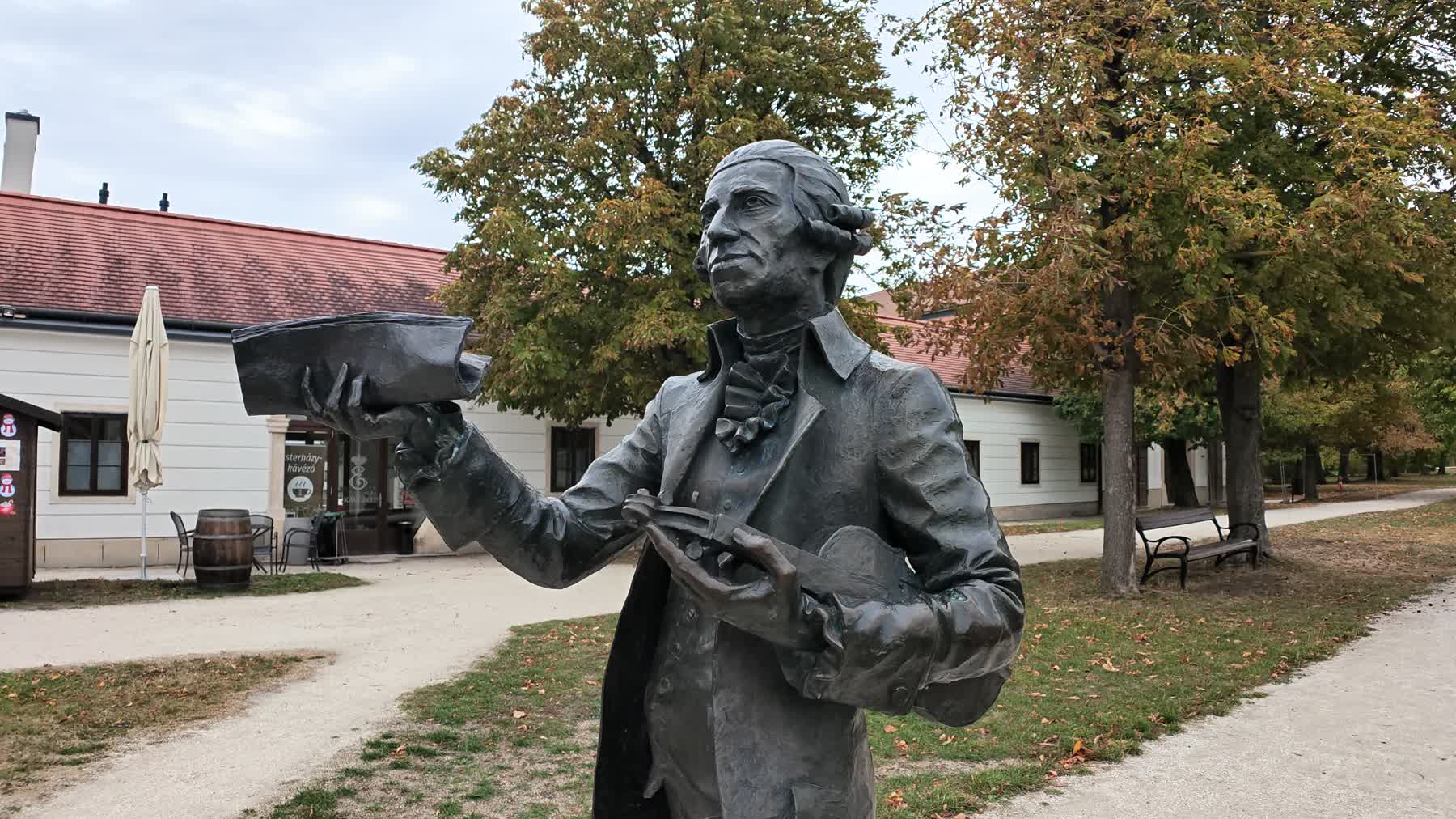
Documentary frames from Ray’s visit footage, supplied separately from the illustrated covers. Credit: Ray Brown / Magyar Minute.
Editorial Clarifications
The transcript preserves the spoken account. The companion article and these notes provide context for compressed or informal statements in the video.
Haydn Spent 24 Years Of His Life On Hungarian Soil.
The video compresses a period of work into a continuous stay. Haydn was associated with Eszterháza across the period from the 1760s to 1790, but the court moved seasonally. The Haydn Foundation dates his regular spring-to-autumn residence in the musicians’ house from 1769; winters were generally spent in Eisenstadt or Vienna.
The Prince Saw Versailles, Wanted One Of Those, And Built It.
This is a simplified origin story. Eszterháza developed around an earlier hunting lodge, and the palace’s own history dates its main transformation from 1762 to 1784. “Hungarian Versailles” describes its ambition and splendour; it was a project built in stages.
My Dad Recently Received A Star On The Hollywood Walk Of Fame.
For precision, the star honours WAR collectively, including original drummer Harold Brown. The Hollywood Chamber of Commerce dates the ceremony to 5 June 2025. It is a band star, rather than a separate individual star.
The Space Is Big Enough For Taylor Swift, Beyoncé, Bad Bunny Or Coldplay.
This is Ray imagining the setting as a producer, rather than a verified assessment of touring-show capacity or an announcement. The palace advertises event spaces, but suitability for any particular production would require approval and an assessment of capacity, access, staging and heritage constraints.
Sources And People
- Esterházy Palace And Eszterháza Center: Official history, visiting information and current programme in Fertőd.
- Csilla Sütő: Managing director of the Eszterháza Center and our host on 22 October 2026.
- Alpár Kató And Daily News Hungary: My friend Alpár invited me on the visit. He founded Daily News Hungary.
- Joseph Haydn Chronology: The International Joseph Haydn Private Foundation on his work, residences and the Farewell Symphony.
- The Palace’s Wartime Damage And Restoration: Art historian Terézia Bardi’s account records the Soviet military hospital and restoration beginning in 1957.
- Cziráky Margit Rose Garden: The palace describes a garden of nearly 8,000 rose bushes.
- Haydn’s Farewell Symphony: Historical discussion of the musicians’ families, the 1772 instruction and Haydn’s musical appeal.
- Reading The Ceremonial Hall: Kuny Domokos Museum archive record explaining the hall’s decoration, wartime losses, crop storage and reconstruction in 2010 and 2011.
- Eszterháza After 1790: The National Heritage Institute on the court’s departure, the orchestra’s dissolution and the estate’s decline.
- Hungary Under Soviet-Backed Communist Rule: A 1949 US State Department policy statement describes Soviet troops in Hungary and the consolidation of Communist rule.
English Transcript
Read The Spoken Account
8,000 rose bushes. And that’s just the garden. A few days ago, I got to visit the Esterházy Palace in Fertőd, Hungary, right out near the Austrian border. I went with my friend Alpár, founder of Daily News Hungary. He invited me to it, and he made the trip an absolute pleasure. I’m a producer, not a cameraman, but I couldn’t help capturing it, because this place has a story. Over 250 years ago, a Hungarian prince named Nicholas Esterházy, nicknamed the Magnificent, decided he wanted a palace that could stand next to the homes of kings. He had taken a trip to France and seen Versailles, which is a giant palace outside Paris where the French kings lived. Think of the most over-the-top house you can imagine, with gold, mirrors, and gardens that go on forever. He looked at that and said, ‘I want one of those.’ And he built it. It has 126 rooms. People still call it Hungarian Versailles. And I’ll tell you, every room stopped me in my tracks. You walk into one and think, ‘Nothing tops this.’ Then you walk into the next one and it does. One is covered in black lacquer with gold paintings in the Chinese style, which was the hottest trend among rich Europeans back then. Kind of like collecting designer sneakers today. But that was just one of many. The prince wanted the best of everything. He also had a composer on staff. His name was Joseph Haydn. And he’s one of the most famous composers in history. He’s called the father of symphony and even taught a young Beethoven. No, no. Try again, Beethoven. Haydn wasn’t Hungarian. He was Austrian. But he spent 24 years of his life on Hungarian soil. And you can hear Hungary in his music. He wrote for the prince’s orchestra and the opera house. And one of the most famous pieces, the Farewell Symphony, came from this place. The musicians were stuck out there for months, away from their families. In the last part of the piece, the players blow out their candles and walk off the stage one by one until only two violins are left. The message to the prince was simple. Let us go home. Arrange to get them home. Safely. I think he got the hint. You know, I think about that a lot, because I grew up around music. My dad was part of a well-known band in the ’70s, and he recently received a star on the Hollywood Walk of Fame. So walking through a place where music meant everything, on Hungarian soil, hit me personally. I know what it feels like to watch a crowd lose it for a band. That building was doing it long before any of us were born. Csilla Sütő, the CEO of Eszterháza Center, the organization that runs the palace, walked us through the whole place. She told us about the restoration, the people it takes to keep the palace going. She also told us they’ve hosted events there. You know, I had an interesting thought. If I was making a film, a period piece, this would be a great location. Anybody interested in doing a film? Count me in. If you booked a concert, think about this. I can only imagine if my dad’s band and their promoters had known about this back in the ’70s. They would have jumped on it. A band at its peak: Taylor Swift, Beyoncé, Bad Bunny, Coldplay. The space is big enough for any of them. And if you’re in Hungary and want to see something outside of Budapest that will blow your mind, come out, walk the grounds, and spend a day like I did. My name is Ray. This is Magyar Minute. Haydn’s players walked out one by one, but the music never left the palace.
Magyar Minute · Ray Brown
hello@magyarminute.com · Contact · Licensing & Press Use
Prepared 30 October 2026. Media resources for editorial enquiries and agreed licensed use.