
Inside Hungary’s Versailles: The Story Behind Esterházy Palace
Behind the splendor of Esterházy Palace in Fertőd are Haydn’s working musicians, a Soviet inscription and decades of restoration. A visit with Csilla Sütő reveals the people and history behind Hungary’s Versailles.
Esterházy Palace, Fertőd, Hungary
Notes
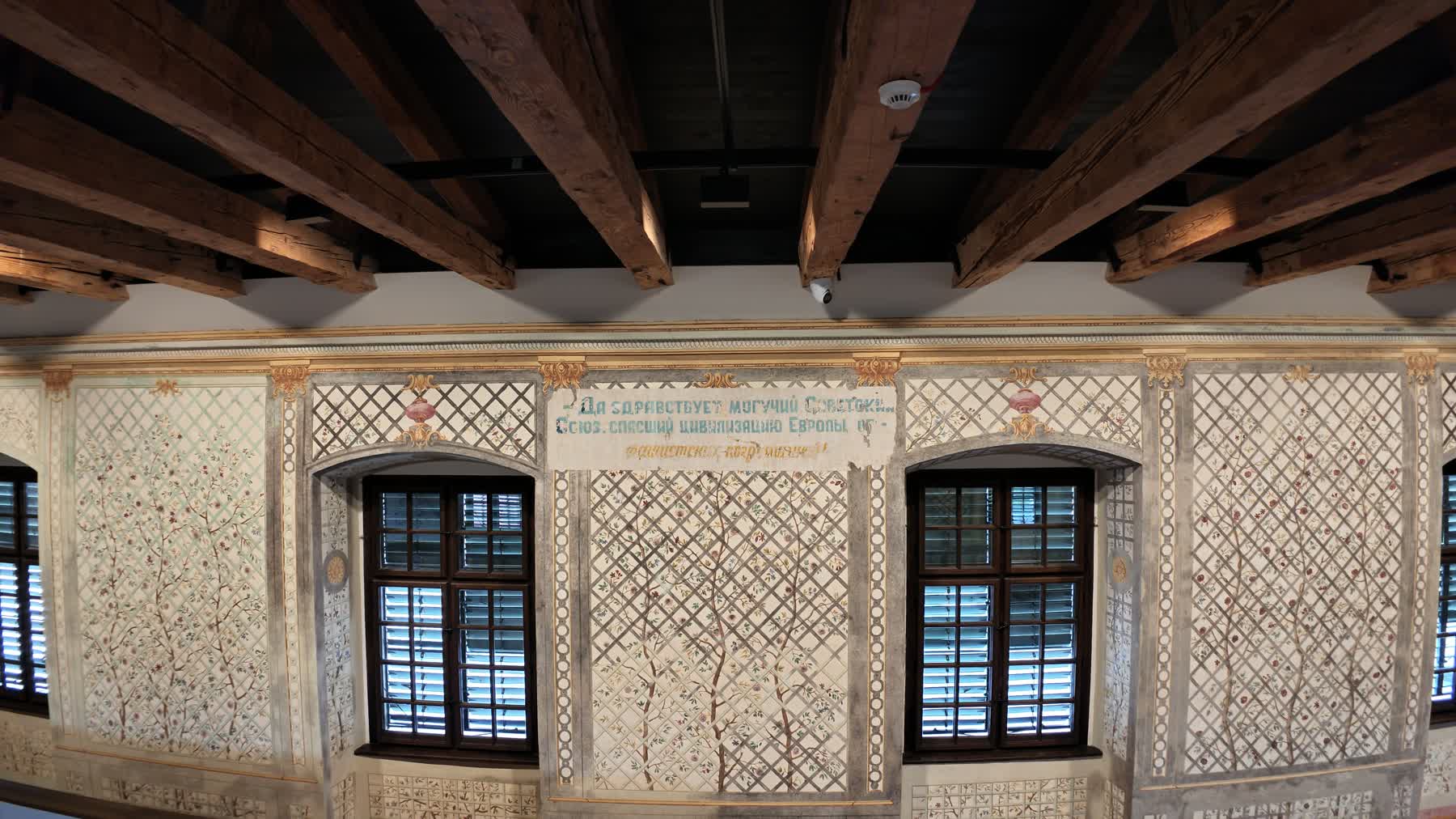
There is a Russian inscription on a wall high inside Esterházy Palace. Its message praises the Soviet Union for saving European civilization from fascism. Around it, the Belvedere still carries the decorative patterns of a very different world.
I saw it during my visit to Fertőd on 22 October 2026, and it stayed with me. The palace is usually introduced as Hungary’s Versailles. That name prepares you for extraordinary rooms and vast gardens. The inscription brings you into the twentieth century, when soldiers occupied the building, furnishings disappeared and parts of a princely residence became a military hospital.
I went with my friend Alpár Kató, founder of Daily News Hungary. Csilla Sütő, managing director of the Eszterháza Center, showed us around. The longer we walked, the more the visit became a story about what people have asked this building to be, and what it takes to keep it alive.
What A Prince Wanted People To See
Prince Miklós Esterházy, known as the Magnificent, expanded an earlier hunting lodge into a residence intended to rival royal courts. Major construction continued from 1762 into the 1780s. A visitor arriving here was meant to recognize wealth, taste and influence.
You can read that ambition in the ceremonial hall. The ceiling painting depicts Apollo’s triumph. Statues of the four seasons stand in the corners, while military motifs appear in the decoration. The Kuny Domokos Museum’s Account connects those seasonal figures with the agricultural wealth that supported the estate. The room presented an image of order and abundance, paid for by the land beyond the palace grounds.
The music belonged to that display. An orchestra, singers and theaters gave the court the means to entertain important guests and sustain an ambitious program. Maria Theresa’s visit in 1773 was an occasion for exceptional spectacle, including a performance in the newly completed marionette theater. Art, hospitality and political standing came together here.
The Musicians Behind The Splendor
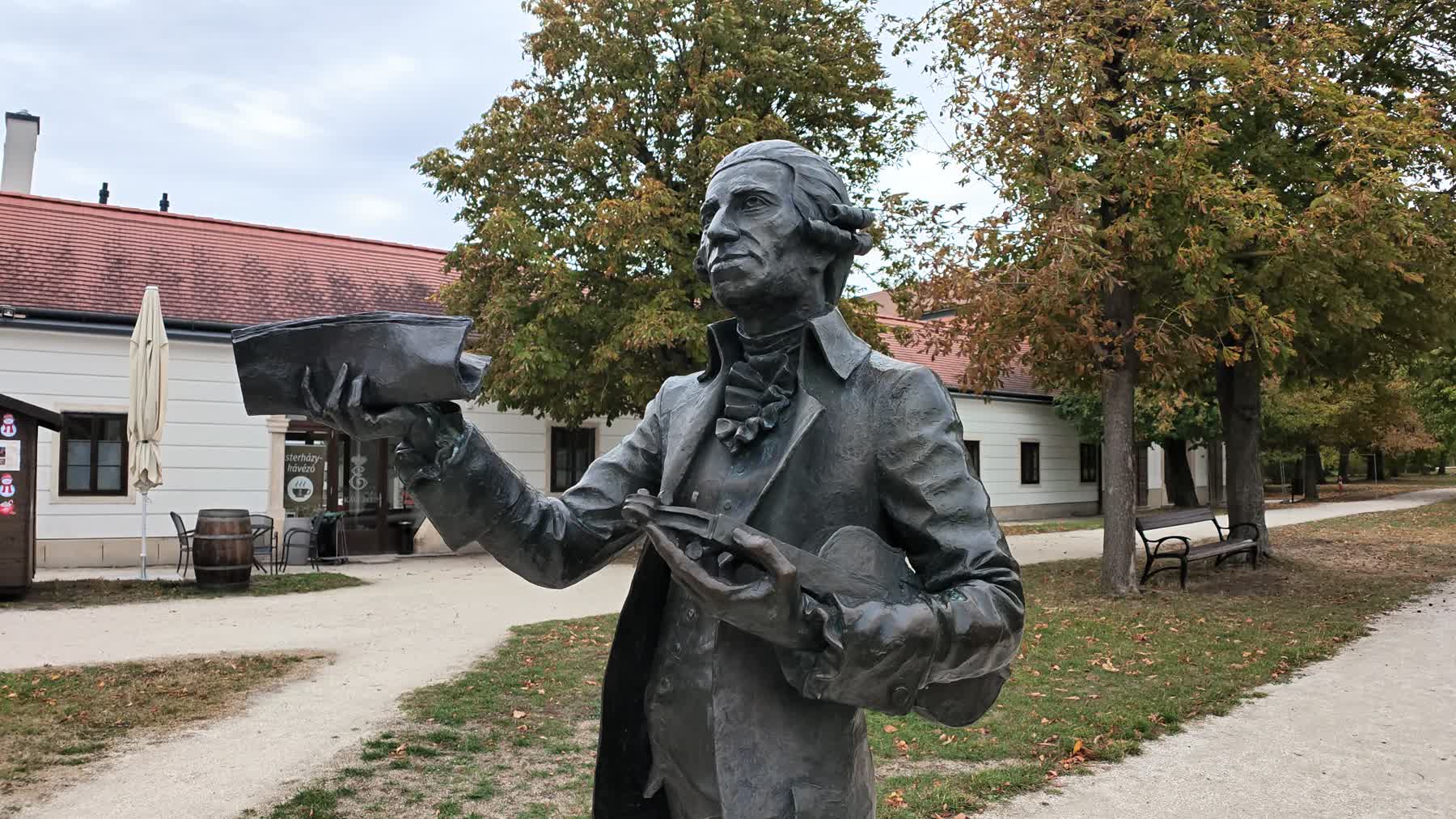
Haydn worked within that household as Kapellmeister, directing its musical life. The court moved between residences. From 1769, he regularly spent spring to autumn in Eszterháza’s musicians’ house; winters generally took him back to Eisenstadt or Vienna. The palace provided resources and performers, alongside the demands of an employer.
His contracts make that relationship tangible. The Haydn Foundation’s Chronology notes that his new contract in 1779 removed a restriction requiring the prince’s approval for outside commissions. His growing reputation existed alongside a job whose terms controlled whom he could write for.
Growing up around My Dad’s band, and later working as a music producer and performer myself, gave me a particular interest in that side of the palace: the people who made the music happen.
The Farewell Symphony gives those people a place in the story. In the familiar account, Haydn’s musicians wanted an extended stay at Eszterháza to end so they could return to their families. His symphony of 1772 ends with players falling silent, extinguishing their candles and leaving, until two violinists remain.
There is a harder detail behind the charming anecdote. Haydn2032’S Historical Commentary reproduces a January 1772 instruction from the prince excluding most musicians’ wives and children from Eszterháza. Accommodation was under pressure. The account of the symphony’s effect comes through Haydn’s later recollections and has acquired different versions, but the separation was real. The performers’ lives depended on decisions made above them.
That makes the ending worth listening to again. Each departing player changes what the audience can hear. The final quietness gives absence a sound.
When The Court Moved On
The palace’s fortunes changed long before the Soviet army arrived. After Miklós died in 1790, his successor Antal reduced the court, dissolved the orchestra and moved his residence to Eisenstadt. The National Heritage Institute records the decline that followed. Eszterháza’s buildings depended on the money, staff and activity that had sustained them.
The family returned around the turn of the twentieth century, carrying out renovations and reshaping the gardens. Then the Second World War brought another rupture. Art Historian Terézia Bardi’s History records the Soviet military hospital, the destruction and dispersal of furnishings, and subsequent nationalization.
The inscription in the Belvedere belongs to that occupation. Its language celebrates liberation. In Hungary, the defeat of Nazi power was followed by Soviet Domination And Communist Dictatorship. Standing in front of the words, you encounter the occupying army’s account of itself inside a building bearing the consequences of its presence.
Leaving those words visible lets visitors encounter that part of the past. The wall carries an uncomfortable historical record alongside its decoration. You can admire the palace and still ask who controlled it, what happened here and whose version of events survives.
What Has Been Brought Back
Restoration began in 1957, and a palace museum opened in 1959, the two-hundredth anniversary of Haydn’s death. The work has continued through later campaigns. The rooms we see now contain the results of decades of research, repair and reconstruction.
The ceremonial hall makes the scale of that recovery concrete. According to the museum’s archive record, its four wall paintings were destroyed at the end of the war. In the early 1950s, crops were stored in the damaged hall. Work began in 1957, but a full reconstruction of the room followed only in 2010 and 2011.
It is difficult to hold both images in your mind: a room designed for princely ceremony, and the same room used to store a harvest. The restored surface can make the intervening damage hard to imagine. Historical photographs and records help visitors understand how much had to be recovered, and why today’s appearance should never be taken for granted.
A Palace People Can Use
Csilla’s work raises a further question: once the building has been restored, who comes through the doors?
In our interview, she spoke about activities for local families and schoolchildren, music sessions for babies and parents, classical concerts and events aimed at younger audiences. She described people coming for an event in the park and becoming curious about what else the palace contains. That first visit can begin a longer relationship with the place.
There is a practical ambition behind that. A family living nearby can return for an afternoon. A school can use the rooms to make history tangible. A concert can give someone a reason to visit who might never have booked a palace tour. The Current Program shows the range of uses the estate is trying to sustain.
The former producer in me could imagine filming here. But the work Csilla described also made me think about the ordinary organization behind an extraordinary setting: finding an audience, caring for the rooms and giving people a reason to return.
Allow time at Fertőd to look at those different histories together. Listen to Haydn, walk the grounds, and look up at the inscription. The splendor has a story. So do the damage, the recovery and the people deciding what happens here next.
Fact Check
A few points from the video, checked against the record.
In The VideoHaydn spent 24 years of his life on Hungarian soil.
Setting It StraightThe video compresses a period of work into a continuous stay. Haydn was associated with Eszterháza across the period from the 1760s to 1790, but the court moved seasonally. The Haydn Foundation dates his regular spring-to-autumn residence in the musicians’ house from 1769; winters were generally spent in Eisenstadt or Vienna. Source
In The VideoThe prince saw Versailles, wanted one of those, and built it.
Setting It StraightThis is a simplified origin story. Eszterháza developed around an earlier hunting lodge, and the palace’s own history dates its main transformation from 1762 to 1784. “Hungarian Versailles” describes its ambition and splendor; it was a project built in stages. Source
In The VideoMy dad recently received a star on the Hollywood Walk of Fame.
Setting It StraightFor precision, the star honors WAR collectively, including original drummer Harold Brown. The Hollywood Chamber of Commerce dates the ceremony to 5 June 2025. It is a band star, rather than a separate individual star. Source
In The VideoThe space is big enough for Taylor Swift, Beyoncé, Bad Bunny or Coldplay.
Setting It StraightThis is Ray imagining the setting as a producer, rather than a verified assessment of touring-show capacity or an announcement. The palace advertises event spaces, but suitability for any particular production would require approval and an assessment of capacity, access, staging and heritage constraints. Source
Spot something off in this video?Suggest A Correction
Mentioned In This Video
Places
- Esterházy Palace And Eszterháza CenterOfficial history, visiting information and current program in Fertőd.View Map
- Cziráky Margit Rose GardenThe palace describes a garden of nearly 8,000 rose bushes.View Map
People
- Csilla SütőManaging director of the Eszterháza Center and our host on 22 October 2026.
Sources & References
- Alpár Kató And Daily News HungaryMy friend Alpár invited me on the visit. He founded Daily News Hungary.
- Joseph Haydn ChronologyThe International Joseph Haydn Private Foundation on his work, residences and the Farewell Symphony.
- The Palace’s Wartime Damage And RestorationArt historian Terézia Bardi’s account records the Soviet military hospital and restoration beginning in 1957.
- Haydn’s Farewell SymphonyHistorical discussion of the musicians’ families, the 1772 instruction and Haydn’s musical appeal.
- Reading The Ceremonial HallKuny Domokos Museum archive record explaining the hall’s decoration, wartime losses, crop storage and reconstruction in 2010 and 2011.
- Eszterháza After 1790The National Heritage Institute on the court’s departure, the orchestra’s dissolution and the estate’s decline.
- Hungary Under Soviet-Backed Communist RuleA 1949 US State Department policy statement describes Soviet troops in Hungary and the consolidation of Communist rule.
Want The Full Transcript?
Get a clean, printable PDF of this video's transcript. Drop your email and we'll send it over.

Share This Story
Point a phone camera at the code to open this page, or download it to share anywhere.
Download QRWhich Place Beyond Budapest Deserves A Closer Look?
Tell Ray
Share Or Use This Story
Pass It On. Give It A New Audience.
Share the link with someone who would enjoy it, or use the cover and suggested caption to introduce the story.
Get The Cover And Caption
 Download Landscape Cover ↓Request Permission To Republish →
Sharing a link is welcome. Republishing the article, video, or images requires permission.